Fracht Group Australia Logistics News - August 2026
1/8/2026
"The secret to success is to do the common things uncommonly well."
- John D Rockefeller
Around the World
- WALLENIUS WILHELMSEN’S PURE CAR AND TRUCK CARRIER Morning Concert has safely exited the Strait of Hormuz after remaining in the Persian Gulf since the Israel-US-Iran conflict escalated earlier this year. The company said the decision followed a comprehensive risk assessment with crew safety as the overriding priority, and the vessel departed via Omani waters. Wallenius Wilhelmsen noted that the Middle East accounts for around 10% of global deep-sea vehicle trade and that 14 vessels from various operators had previously been trapped in the strait. While the conflict was estimated to have reduced the company’s revenue by 2%, this was offset by stronger demand from Chinese manufacturers. Longer voyage times have also been recorded on routes serving the Middle East.
- SEVERE CONGESTION AT JEDDAH continues to disrupt cargo movements, with truck queues extending more than five kilometres outside the port and delays affecting both container pick-ups and empty returns. Terminal congestion has reportedly pushed yard density to 90%, reducing productivity and prompting Hapag-Lloyd to suspend certain cross-border bookings through Jeddah. Forwarders reported little improvement in operating conditions, complicating efforts to use Gulf land bridge solutions following disruptions in the Strait of Hormuz.
- RENEWED CONFLICT INVOLVING IRAN AND THE UNITED STATES has again disrupted vessel traffic through the Strait of Hormuz, prompting Gulf importers and logistics providers to increase use of Middle East land bridge routes. The situation escalated after the 7,000 TEU (twenty-foot equivalent unit) GFS Galaxy was attacked while transiting the strait, resulting in the vessel catching fire and its crew abandoning ship. Sea-Intelligence reported that freight rates on Middle East-related trades have surged sharply as a consequence, with rates on some routes increasing by more than 250%. While global average container rates remain below pandemic highs, several Middle East corridors, including intra-regional and Europe-Middle East trades, have reportedly exceeded the peak rates experienced during the Covid-era supply chain disruptions.
- LOW WATER LEVELS ON THE RHINE RIVER are again affecting inland shipping operations in Germany, disrupting vessel utilisation and contributing to rising transport costs across parts of Europe. Reduced river depths limit cargo loads on inland barges, requiring additional sailings and alternative transport arrangements to move the same freight volumes. The situation is creating operational challenges for supply chains that rely on the Rhine, one of Europe’s most important inland freight corridors. As water levels remain below optimal operating conditions, logistics providers and shippers are facing increased costs and capacity constraints across river transport networks.
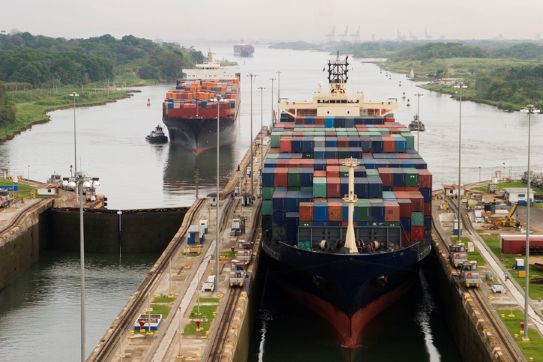
- THE PANAMA CANAL AUTHORITY (ACP) has begun introducing precautionary transit restrictions as forecasts indicate a high probability of a severe El Niño weather event. Measures already announced include the cancellation of short-notice booking auctions at the Panamax locks, reducing daily transit capacity from 36 to 34 vessels. The ACP said any broader restrictions on vessel draughts or booking slots would depend on future weather and market conditions. Lessons learned from the 2023-24 drought, when canal transits were reduced by as much as 50%, are guiding current planning. Several carriers have already responded, with MSC and CMA CGM introducing Panama Canal surcharges to offset anticipated operational constraints and higher transit costs.
- MORE THAN 100 CONTAINERSHIPS have reportedly changed registry from Panama to alternative flags following increased inspections and detentions of Panama-flagged vessels in Chinese ports. According to shipping analysts, detentions of Panama-registered containerships have risen significantly since March, prompting owners to reflag ships to registries including Liberia, the Marshall Islands and the Bahamas. The development follows Panama’s decision earlier this year to reassign major port concessions at Balboa and Cristobal. Chinese authorities have defended the increased scrutiny, citing a disproportionately high number of maritime accidents involving Panama-flagged vessels in Chinese waters. Industry observers have also reported that some Chinese finance lessors are now requiring newly built vessels to be registered outside Panama.
Seafreight News
- MEDITERRANEAN SHIPPING COMPANY has restored Brisbane calls to its Noumea Shuttle service, reversing changes made during earlier Oceania network revisions. From 3 July, the service rotation is Port Botany, Brisbane, Noumea, Lautoka, Suva, Tauranga and Port Botany. The reinstatement gives exporters renewed direct access to New Caledonia and Fiji, with onward access to New Zealand.
Separately, the A3 Consortium’s weekly service has been populated with five vessels on a weekly rotation of Qingdao, Shanghai, Shekou, Melbourne, Port Botany, comprising two from ANL, two from COSCO Shipping and one from OOCL, with the first sailing from Qingdao scheduled for 28 July. - CAPACITY ON THE CHINA TO AUSTRALIA TRADE remains tight, with forwarders reporting booking difficulties amid surcharges, delays and ongoing port congestion. Global freight rates continue to climb, while Drewry’s World Container Index rose another 9% recently, led by transpacific gains. In contrast, Drewry’s Intra-Asia Container Index fell 4%, with analysts pointing to easing congestion and reduced front-loading. For Australia, one carrier replaced a planned Peak Season Surcharge with an Emergency Space Surcharge, reflecting active management of constrained vessel space. Congested ports listed included Shanghai / Ningbo, Singapore, Qingdao, Busan, Hamburg, Bremerhaven and Antwerp.
- GLOBAL CONTAINER PORT CONGESTION has reached a four-year high, with nearly 3.7 million TEU, or 11% of the global fleet, tied up awaiting berths. North Asia accounted for 38% of global congestion, followed by North Europe at 13%, and South-East Asia, the Mediterranean and Africa at 9% each. Severe delays were reported in Benelux and German ports, while waiting and dwell times were also recorded at Singapore, Shanghai and Rotterdam. The congestion, combined with demand growth exceeding vessel supply growth, supported further freight rate increases across Asia-Europe and transpacific trades.
- THE CONTAINER CHARTER MARKET has strengthened despite the traditionally quieter summer period, supported by higher freight rates and improved liner profitability. Braemar reported healthy chartering activity, with operators returning for contract extensions and forward fixtures as effective vessel supply remains constrained by congestion. Demand is increasingly evident in larger vessel classes, where available 2026 tonnage is already limited. Market reports cited Maersk fixing two 14,000 TEU newbuildings on three-year charters at around US$80,000 per day for 2027 delivery. Braemar also noted tightness in the panamax, sub-panamax and feeder sectors, while rising charter demand, higher rates and stronger liner profits have contributed to increased vessel asset prices.
- MAERSK LINE will resume its seasonal ‘Melbourne Star’ calls from 10 August, providing a fast export service from Melbourne to Southeast Asia. The service forms part of Maersk’s Southern Star network, linking New Zealand with Southeast Asia using six vessels of 5,568 to 5,905 TEU. Indicative transit times are 11 days to Tanjung Pelepas and 13 days to Singapore, with vessels calling at DP Worlds West Swanson Dock terminal in Melbourne. The first of eight expected callers is Maersk Rio Negro.
- WALLENIUS WILHELMSEN HAS TAKEN DELIVERY of Arctic Tern, the first vessel in its new Shaper-class pure car and truck carrier (PCTC) series, and deployed it to EUKOR Car Carriers, its joint venture with Hyundai Motor Group. The vessel features dual-fuel capability, methanol readiness and enhanced operational efficiency, forming part of the company’s ongoing fleet renewal program. According to Wallenius Wilhelmsen, the new class has been designed to offer increased cargo capacity, improved fuel efficiency and greater operational flexibility while supporting lower-emission shipping. Arctic Tern will commence service on Asia–Europe trades and is expected to undertake its first methanol bunkering shortly after delivery, supporting the company’s broader decarbonisation objectives and ambition to offer net-zero end-to-end services from as early as 2027.
Airfreight News
- CHINA SOUTHERN AIR CARGO HAS ORDERED five Boeing 777-8 freighters and two additional Boeing 777Fs, becoming the first Chinese carrier to commit to the new-generation freighter aircraft. The order, valued at approximately US$3.6 billion at list prices, also includes options for three additional 777-8Fs with deliveries scheduled between 2027 and 2034. The carrier said the investment reflects continued growth in cross-border e-commerce, overseas market expansion and the need to optimise fleet structure and capacity. The airline currently operates 19 Boeing 777Fs and expects the new aircraft to strengthen competitiveness and support long-term growth opportunities linked to regional economic initiatives and international trade development.
- EMIRATES SKYCARGO PLANS TO LAUNCH its first transpacific freighter service, operating a round-the-world rotation linking Dubai, Hanoi, Anchorage, Chicago and Europe to capitalise on rising demand for technology, electronics and AI-related cargo. The carrier said strong cargo growth from Vietnam has been a key driver behind the expansion. At the same time, Emirates will phase out its temporary passenger-freighter operations introduced during the Iran-US conflict as passenger demand returns to normal levels. The airline has expanded its freighter fleet significantly during 2026 and expects further growth as new aircraft are delivered.
- GLOBAL AIR CARGO DEMAND CONTINUED to outperform expectations in June, driven by strong demand for semiconductors and AI-related hardware. According to Xeneta, demand grew 7% year-on-year while capacity increased 3%, pushing dynamic load factors higher. AI-related shipments from Taiwan and South Korea were identified as a key contributor, with semiconductor sales growth supporting strong transpacific airfreight volumes despite weaker China-US trade. While e-commerce volumes continued to soften, AI and technology-related cargo more than compensated for the decline. Airfreight spot rates remained elevated across several corridors, particularly those linked to North America and the Middle East.
- FRANKFURT AIRPORT RECORDED CARGO VOLUMES of approximately one million tonnes during the first half of 2026, representing growth of 1% despite disruption from the Middle East conflict and industrial action affecting Lufthansa. Airport operator Fraport said second-quarter performance was impacted by a six-day Lufthansa strike, the grounding of Lufthansa’s A321 freighter fleet and reduced capacity across Middle East routes. Airspace restrictions forced significant changes to cargo networks, resulting in freight being redirected between Europe, Africa and the Far East. Traffic from Asia benefited from these shifts, while Middle East volumes declined nearly 20%. Fraport also reported continued growth in e-commerce-driven freight, although changing regulations have begun to temper demand growth.
- AIR CARGO VOLUMES between Hong Kong and Europe have fallen sharply following the European Union’s introduction of a new EUR3.00 duty on low-value imports from outside the bloc. Data from WorldACD showed Hong Kong-Europe tonnage declined 12% week-on-week in early July, following previous weekly declines and reducing volumes to levels last seen in March. Airlines have responded by cutting freighter capacity, with direct freighter services declining around 19% week-on-week. In contrast, cargo demand from Taiwan to Europe has strengthened, driven by increased shipments of AI-related technology products. Overall, Asia-Pacific to Europe volumes also softened, reflecting the broader impact of the new customs measures and changing e-commerce trade flows.
Oceania Ports and Airports
- THE PORT OF FREMANTLE recorded its strongest March vehicle throughput in three years, handling 10,572 new vehicles during March 2026, compared with 9,884 in March 2025 and 8,947 in March 2024. The increase reflects a recovery in global automotive supply chains and more consistent roll-on/roll-off vessel scheduling. Used vehicle imports also rose year-on-year, while vessel calls increased from 15 in March 2024 to 18 in March 2026. Fremantle remains Western Australia’s primary gateway for passenger vehicle imports and processed a record 128,239 new vehicles during the 2023–24 financial year. Port operations have reportedly kept pace with growing volumes through available berth capacity and landside processing infrastructure.
- TRIAL CARGO OPERATIONS have commenced at Western Sydney International Airport ahead of the official opening of its integrated cargo precinct. The first test flight involved a Qantas Freight A321 freighter, marking the final phase of the airport’s operational readiness program. Additional trial flights will be conducted prior to the commencement of commercial services. Cargo precinct partners include Menzies Aviation, dnata Cargo and Texel Air. Airport management said the precinct has been designed using modern technologies to provide an efficient and future-focused freight facility. Once operational, the precinct is expected to handle up to 220,000 tonnes of freight annually and significantly increase Sydney’s air cargo capacity.
- THE PORT OF NEWCASTLE has become the first port in New South Wales approved to store grid-scale lithium-ion batteries at its Mayfield Multipurpose Terminal. The approval, granted by the NSW Government, has already enabled the port to receive and store batteries destined for major energy projects, including the AGL Tomago Battery, Origin Energy Eraring Battery and the Bellambi Heights Battery Energy Storage System. Together, the projects represent approximately 1.7GW of dispatchable capacity and 6.8GWh of energy storage. The development strengthens the port’s role in renewable energy logistics and project cargo handling, while supporting broader infrastructure investment, including a AUD36 million berth extension project and additional storage capacity for future energy-related cargo.
- FIJI PORTS CORPORATION HAS PROPOSED new tariffs of up to 48% on selected international shipping services to support a FJD 910 million, ten-year infrastructure investment program. The corporation advised the Fijian Competition and Consumer Commission that approximately FJD 393 million is urgently required for critical infrastructure upgrades, rehabilitation projects and capacity expansion across key ports. According to the submission, much of Fiji’s port infrastructure dates back to the 1950s and is operating under increasing pressure from larger vessels and higher cargo volumes. No tariff increases have been proposed for domestic shipping services, and the corporation stated that the overall impact on import costs and end consumers is expected to remain minimal.
Customer Service
Fracht Group Australia - keeping your supply chain moving. For further information or tailored guidance of any of the topics covered, please contact your Fracht representative or our friendly team at fracht@frachtsyd.com.au
Share this news via